
'You have to have commitment to both, but it has to be done at the individual level.'

... if high oil prices persist or stock prices correct sharply.

Nearly 40 per cent of IITians sitting for placements in 2024 are yet to receive job offers, showing a doubling of the 'unplaced' in the last three years from 19 per cent in 2021-2022 to 38 per cent in 2023-2024.

The BJP lost 15 of the 80 Lok Sabha seats in 2019. Union ministers have been deployed in all 15, tasked with turning the result around.

'We are developing infrastructure on the mountains and deploying the troops on hill borders in such a way that it is ensuring the safety of the people there.'

Rahul said that the purpose of the party's 'Bharat Jodo Yatra' is to remove fear from the people's minds and highlight issues like price rise and unemployment.
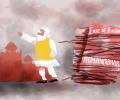
Improved monsoon, solid fiscal performance, and capex push by the public and private sectors augurs well for India's macroeconomic stability and growth, the finance ministry's monthly economic review for June 2023 said. But the report said that while India's domestic fundamentals remain strong, negative cross-border spillovers and adverse global developments could act as a deterrent in achieving the high growth path this financial year. "An improved matching of aggregate supply and aggregate demand in the Indian economy underpins the progress made in the control of domestic inflation and the consequent strengthening of macroeconomic stability," the review said.

A group of ministers, headed by Agriculture Minister Sharad Pawar, has been formed to resolve inter-ministerial differences stalling the national manufacturing policy which aims at giving a boost to the sector.

Banerjee claimed that some people will try to "engineer riots" during elections and urged everyone "not to fall prey to the plot".

Nikkei 225 index hit the 40,000 mark for the first time ever on Monday, continuing its bull-run that saw the index reclaim its 1989 peak of 34,000 levels in February. as global investors latched on to Japan's biggest companies on improving shareholder returns, the weaker yen and booming corporate profits. Analysts remain bullish on Japan, mostly aided by gains in technology shares. Adoption of artificial intelligence (AI), according to a note by Morgan Stanley, is likely to benefit Japanese companies, which is almost at par with the US-based companies.

With the threat of a third Covid-19 wave looming large, companies are scrambling to protect employees and keep operations safe--from a no-jab-no-entry-at-workplace policy to ramping up vaccination, it's an all-out effort to prevent the scale of devastation seen in the first two waves. At least two top steel companies--Tata Steel and ArcelorMittal Nippon Steel India (AM/NS India)--are pushing for vaccination certificates for entry into work premises. AM/NS India, a joint venture between world's leading steelmaker, ArcelorMittal, and Japan's Nippon Steel, is set to make vaccination the certificate a requirement from July 1.
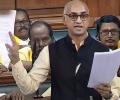
'If businessmen should be included in the political process -- which is essential in my opinion -- they need to have the freedom to express themselves and to take stands against the government of the day, without fear of reprisals and attacks on their business.'

Narendra Modi's pay-off from relaxing labour laws would be huge.

China, the world's most populous nation, will relax its controversial decades-long one-child population policy which restricted most couples to have only a single child, the ruling Communist Party announced on Friday.

The coveted QS rankings indicate that India is slowly but steadily overtaking other nations in the field of education.

Continuing his tirade against Raghuram Rajan, BJP MP Subramanian Swamy on Friday said RBI Governor's policies have finished small industries and are anti-agriculture.

Manufacturing activities in India fell to a five-month low in September as new orders rose at a softer pace, which tempered production growth, a monthly survey said on Tuesday. The seasonally adjusted S&P Global India Manufacturing Purchasing Managers' Index (PMI) fell to 57.5 in September, down from 58.6 in August -- the lowest in five months. The September PMI data pointed to an improvement in overall operating conditions for the 27th straight month.
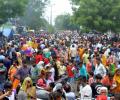
On the ground, rural medical infrastructure and more crucially, women's access to reproductive health services is practically non-existent in Uttar Pradesh, reports Geetanjali Krishna.

The five warmest years in Indian weather history have occurred in the past 14 years -- the others being 2009, 2017 and 2010, in order of intensity.

Finance Minister Arun Jaitley said it has been decided to fix the minimum wages at Rs 350 per day for unskilled non-agricultural workers for 'C' category areas keeping in view the modalities of fixing minimum wages.
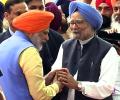
Whether it was the MGNREGS or the NFSA or the Aadhaar-based DBT scheme for cash transfer, the Modi government has built on the basic architecture created by the Singh government. Policy makers in the Modi government, instead of discarding them as products of the previous political regime, worked on them, expanded their scope and reach, and used new tools to improve their performance, explains A K Bhattacharya.

Never mind work-life balance: this generation spends more time on the job than ever before.

Union Agriculture Minister Arjun Munda on Tuesday said a law guaranteeing minimum support price (MSP) on crops cannot be brought in a hurry without consulting all stakeholders and urged the protesting farmer groups to have a structured discussion with the government on the issue.

The government is targeting export of goods and services worth $2 trillion by 2030.
As the problem of job losses in the domestic economy continues to grow, Prime Minister Manmohan Singh will again take up the issue of "protectionist policies" by advanced countries during his G-20 tour. The Union government feels that these policies will add to the massive job losses in the country, especially in labour intensive sectors engaged in exports.
The more sectors contribute to growth, the more employment growth will generate. There are no short cuts.
The 48-hour nationwide strike called by central trade unions hit normal life across Kerala on Wednesday with workers from varied sectors, including transport and banking, staying away from work to protest the UPA government's economic and labour policies.

'In the short term the relationship will get worse.'

Indian policymakers must realise that in buying small quantities of equipment, it becomes hard to start manufacturing them in India, explains Ajai Shukla.

What's different this time is that global financial stress -- which has its genesis in four policy choices made in recent years -- is juxtaposed with a more resilient real economy, observes Sajjid Z Chinoy, chief India economist at J P Morgan.

'The pandemic had a significant impact on child trafficking.' 'With economic hardships, traffickers exploited the situation to target desperate parents and children.'

Rajya Sabha Chairman Jagdeep Dhankhar's decision to allow Singh to speak on the Bharat Ratna honour to Charan Singh drew sharp protest from the Congress, leading to a heated exchange of words between the opposition and the treasury benches.

We have the workforce, now we need to ensure that we take full advantage of game-changing technologies and geopolitical openings, suggests Jayant Sinha, chairman, Parliament's Standing Committee on Finance.

If Modi wants to leave a real legacy, breaking India's strategic triangulation would be the real gift, notes Shekhar Gupta.

Prime Minister Narendra Modi made a pitch for electing a strong and stable government in an uncertain world beset by geopolitical tensions as the Bharatiya Janata Party on Sunday released its manifesto, prioritising development and welfare while shunning populist measures and contentious issues like the National Register of Citizens (NRC).

Pointing out that these recent measures are incremental rather than radical, Moody's said, these steps will sustain higher gross domestic product growth and address some of the constraints on the country's sovereign credit profile.
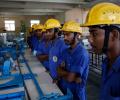
India only has 3.5 million workers undergoing skills courses a year, compared with 90 million in China

She lashed out at the Bharatiya Janata Party, the Samajwadi Party and the Congress, holding them responsible for the lack of jobs and migration from the state.
